
Walk the Buckeye Street Directory
A sound Buckeye search starts with one exact site address. The county assessor translates that text into an Assessor Parcel Number, or APN, plus the titled owner, physical address, mailing address, subdivision, deed reference, and legal geography. Those stable facts keep the street directory tied to land rather than to a similar name. The map then shows nearby parcels. Recorder instruments establish title transfers, while city permit files can add dated work and applicants. A historical reverse directory may identify a listed occupant from a past edition, but it does not describe every person present.
- Enter the full address in the Maricopa County Assessor search. Save the APN, physical address, owner, subdivision, MCR, and deed reference.
- Open Parcel Viewer and select the lots along the chosen Buckeye street. Keep the set small enough to inspect each feature.
- Use the current owner's name and deed number in the Recorder index. Match the legal description before accepting a result.
- Ask Buckeye Development Services for permit records by address or APN when a public portal does not reach the needed project or year.
- For a past occupant, consult a dated reverse directory and compare it with deeds, census schedules, or newspaper evidence from the same era.
This order matters. An address can change form, and a name can repeat. APN, document number, subdivision MCR, lot, and block are much stronger links. A ZIP label alone is weak because postal Buckeye and the incorporated city do not share one boundary. For a full historical shelf method, the Buckeye city directory collections explain how to read and compare editions.
Search Buckeye Streets by Address
The Maricopa County Assessor Property Search is the first official address tool. Its standard form accepts a street number, direction, name, abbreviated type, city, state, and ZIP, though city, state, and ZIP may be omitted. A failed query can often be rescued by leaving off the street type. Search also accepts an APN with flexible punctuation, a full owner name, subdivision, or MCR. That range is useful in Buckeye, where a recorded subdivision name may be more durable than a marketing label.
The Assessor publishes exact search syntax help. The visible parcel record separates the physical, or situs, address from the owner's mailing address. It can also show deed number and date, sale data, construction year, zoning, jurisdiction, and values. These fields build an ownership and property trail. They do not form a full roll of occupants.
| Assessor input | Entry style | Best Buckeye use |
|---|---|---|
| Street address | Number, direction, street, abbreviated type | Translate a site into an APN and owner |
| APN | With or without common punctuation | Return to the exact parcel |
| Owner name | Full unabbreviated name | Find titled parcels linked to a person |
| Subdivision or MCR | Recorded name or map reference | Find lots when street wording fails |
The source view helps show what to expect. Review the official Maricopa property search before entering Buckeye details.
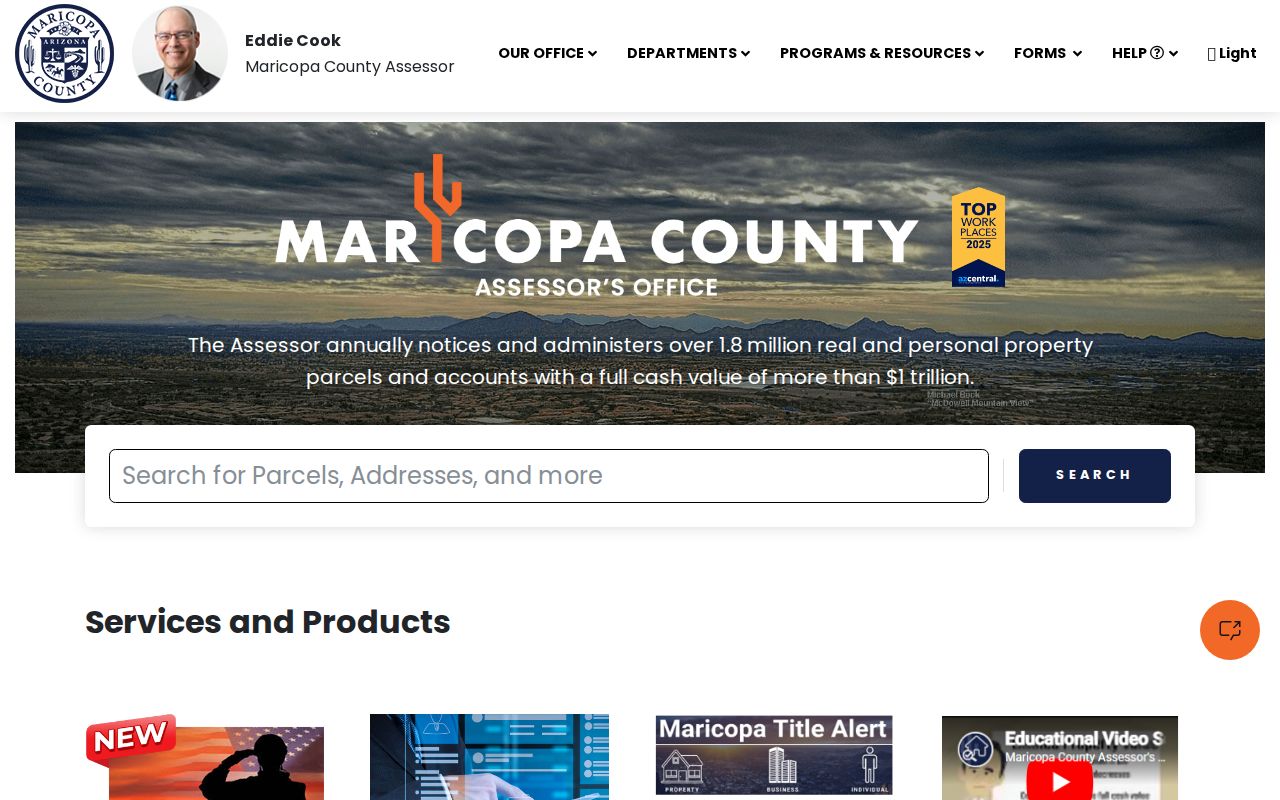
The captured search surface confirms why the assessor belongs at the front of a by-address workflow.
Buckeye Street Directory Search Syntax
Small changes can determine whether a Buckeye street result appears. County guidance favors standard abbreviations and allows the city, state, and ZIP to drop out of the query. Try the exact site number first. Then remove the street type, test the recorded subdivision, or use the APN if a prior source supplies it. Directional prefixes and suffixes should remain distinct. A result that merely resembles the target is not enough.
The Assessor's help screen documents those choices. Its address-search guidance is shown below.
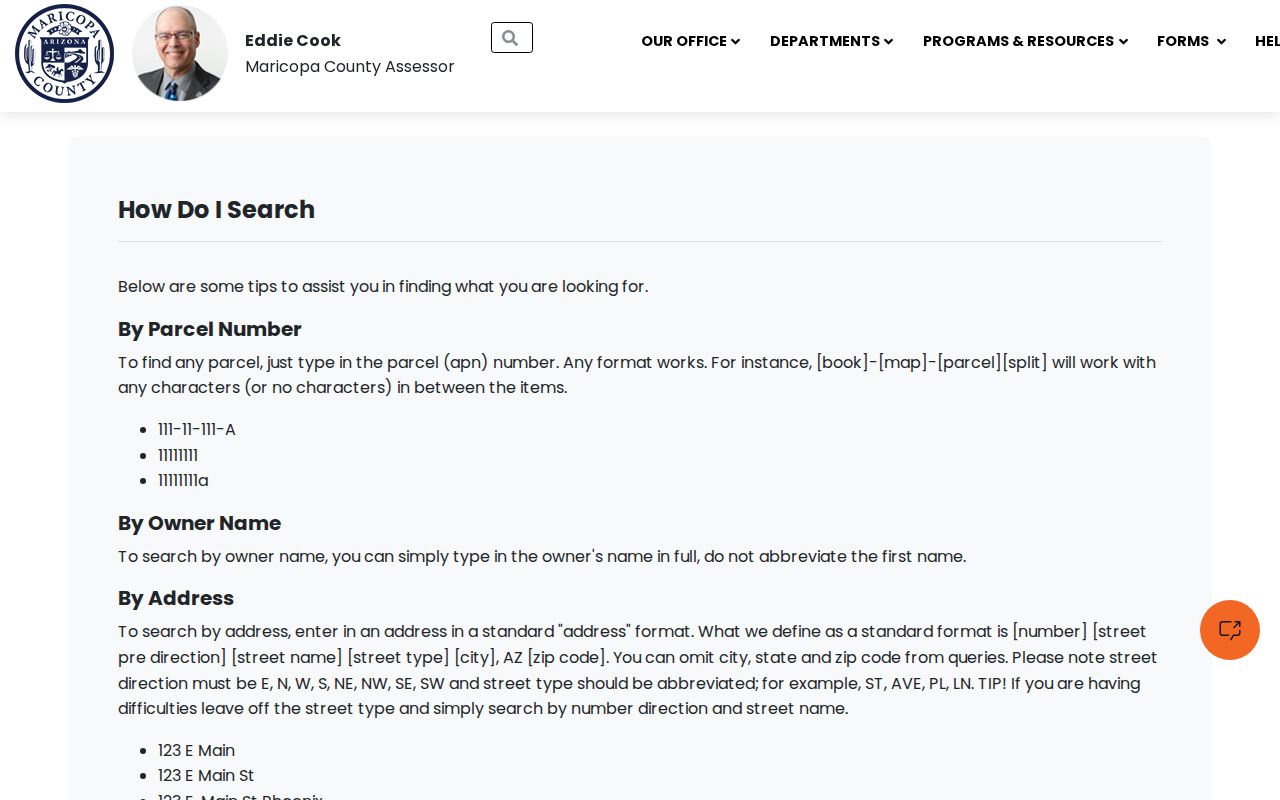
The syntax rules offer a clear fallback before moving to staff help or a parcel-history inquiry. A split or combined parcel that no longer returns under an old APN may require an Assessor parcel-history report.
Note: Omitting the street type can rescue a failed Maricopa address query without changing the target place.
Map Buckeye Streets by Parcel
The Maricopa County Assessor Parcel Viewer turns one parcel into a street segment. Its “What I Know” modes include APN, owner, subdivision, MCR, section-township-range, ZIP Code, Map ID, and personal-property account. Map selection may use a point, line, polyline, extent, circle, polygon, or freehand polygon. Results can replace, add to, or remove from the current set. Each selected feature opens details and zooms to the lot.
Use a narrow shape along the visible street. Broad polygons can pull in unrelated subdivisions. The viewer caps a selected result set at 1,000 features, so a whole Buckeye ZIP or long arterial must be divided into small areas. Save APN and situs facts one parcel at a time. This produces a parcel-owner view, not a verified household list.
- Parcel
- A mapped unit of land identified by an APN.
- Situs address
- The physical location of the parcel, distinct from the owner's mailing address.
- Plat
- A recorded map that divides land into lots, blocks, tracts, or other legal units.
- Criss-cross directory
- A dated directory arranged by street and number rather than only by surname.
Buckeye Records Organized by Street
Each official source answers a different address question. The Buckeye street directory is most reliable when those roles stay separate. The Assessor establishes titled ownership and parcel characteristics. Parcel Viewer adds spatial context. Recorder instruments show transfers and other recorded claims. The Treasurer adds billing and payment context. City permit records describe work at a site. A reverse directory gives evidence about a listed occupant in one published edition.
| Address record | Responsible office | Evidence returned | Available channel |
|---|---|---|---|
| Parcel record | Maricopa County Assessor | Owner, APN, mailing and situs addresses, site facts | Web search, inquiry, Phoenix counter, telephone |
| Parcel map | Maricopa County Assessor GIS | Lot shapes, adjacent parcels, ZIP and legal geography | Free viewer and agency help |
| Recorded instrument | Maricopa County Recorder | Parties, deed type, date, number, legal description | Online index/image, counter, mail, copy request |
| Tax account | Maricopa County Treasurer | Tax bill, history, activity, balance, receipt | Online APN or address search |
| Permit or project | Buckeye Development Services | Site, parcel, applicant, contractor, scope, status dates | Portal or targeted public-record request |
| Reverse directory | Library or archive collection | Listed name at a street number in one edition | Digital volume, library database, reading room |
The county offices also maintain nonportal access. Assessor help is available at the county counter or by inquiry. Recorder staff can locate material through its Phoenix counter, mail channels, and public-data forms when an image or old item is missing. Buckeye Public Records is the fallback for a precise city permit or addressing record.
Follow Buckeye Deeds by Street
An address is not the main key in the Maricopa County Recorder Recorded Document Search. Begin with the Assessor's present owner and deed number. Open that instrument, note the grantor, grantee, date, number, and legal description, then search the seller as an earlier grantee. Match the land description, not the name alone. Trusts, companies, associations, and subdivisions belong in Business Name mode. This is a useful Buckeye quirk because planned-community records may be indexed under a legal organization rather than a street label.
The Recorder index supplies party roles, document code, recording date, number, page count, and an image link when available. Unofficial images are free to inspect. Official copies cost $1 per page, and certification adds $3 per document. When the web trail breaks, the Recorder counter at 301 W. Jefferson Street in Phoenix, mail ordering, and public-data forms remain available. County recording responsibility began in 1871, before Buckeye incorporated, but that fact does not mean every early image is online.
The official recorded-document index shows the name-based starting point.
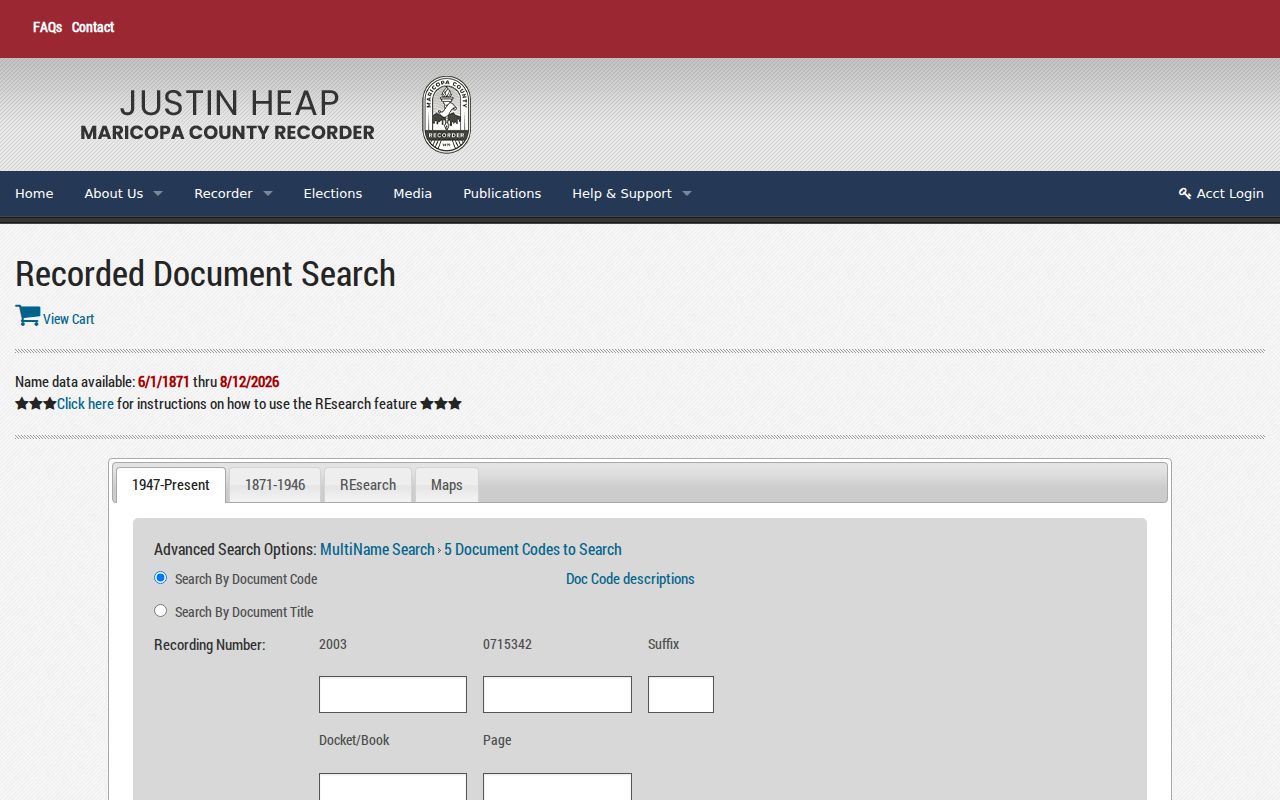
The source image reinforces the key shift from address to owner or business name before a street's deed chain can move backward.
Buckeye Mailing and Situs Clues
Mailing and physical addresses serve different roles. The situs address locates the Buckeye parcel. The mailing address tells where the owner receives tax correspondence and may point outside Arizona. When both match, they can support an owner-occupancy theory, but they still do not prove who else is present. When they differ, do not treat the mailing address as the street being researched.
Parcel Viewer's public layer bridges these facts with deed number and date, sale date and price, subdivision, MCR, construction year, zoning, and jurisdiction. That mix helps distinguish two similar sites. It also shows why a marketing community name, postal place, and legal description must not be merged. The APN and legal map fields are the safer join keys.
Note: A parcel card documents land and title facts; it is not a complete Buckeye resident roll.
Buckeye Streets Across Annexations
Postal Buckeye is not the same geography as incorporated Buckeye. The city's large, irregular annexation footprint means one continuous road can cross city, county, voting, police, fire, school, or community-facilities boundaries. The Buckeye GIS and map gallery publishes streets, annexations, districts, approved community master plans, voting geography, and service layers. Use those maps to identify the office likely to hold an address-based record.
Verrado, Sundance, Tartesso, Festival Ranch or Sun City Festival, Blue Horizons, and other planned areas may work better as subdivision searches. Test the recorded subdivision or association name with the Assessor and Recorder. For a disputed old address, request Buckeye's authoritative address-point or change record by old name, new name, and approximate date. No verified citywide street-renumbering history was found, so a modern basemap should not be used to invent one.
Buckeye Street Permits and Taxes
Permit and tax records add context without proving residence. Buckeye Development Services records may identify a site address, APN, owner, applicant, contractor, work scope, issue or status dates, and inspections. If an old project does not appear in the current portal, send a targeted Buckeye public-record request with the address, APN, permit number if known, approximate years, department, and desired format. Code complaints may have personal details removed.
The Maricopa County Treasurer tax search accepts name, situs address, parcel or account segments, and other supported keys. Its result tabs can show tax summary, history, activity, amount due, receipts, valuation, and detailed statements. The Treasurer bills and collects. The Assessor sets value and class, while the Recorder holds instruments.
The official tax interface is another by-address layer for the Buckeye street directory.
The captured source helps keep tax-account evidence distinct from deed ownership and present occupancy.
Limits of Buckeye Street Records
No Buckeye street search establishes every person at a site. Property sources identify titled owners, not all occupants. A permit may name an applicant or contractor whose role is limited to the project. A directory entry reflects one publication and can omit people. Utility accounts, protected addresses, and private group rosters stay outside the proper public chain. Arizona's voter portal is an individual self-service tool, not a public street-browse product.
A.R.S. §16-168 limits voter-list purposes, blocks Internet redistribution, withholds sensitive fields, and makes misuse a felony. A generic records request cannot override those limits. The Arizona Address Confidentiality Program and related protected-address rules must be respected. Stop when a source is sealed, redacted, private, or restricted. Record uncertainty instead of filling a gap with a guess.
Lawful use. Use Buckeye address records only for lawful personal research. Arizona law prohibits stalking and harassment, and protected address safeguards must never be defeated.