
Buckeye Directory Collections by Year
Buckeye appears inside regional Arizona volumes rather than a proven run of Buckeye-only books. Three editions are verified. Each is a real point on the Buckeye city directory timeline, but none proves that every year between them survives. Check the title page and publication date before attaching an entry to a family. The city directory evidence becomes stronger when the same name, spouse, route, or street also appears in another source.
| Collection | Verified years | Where held | Access route |
|---|---|---|---|
| Phoenix City and Salt River Valley Directory | 1916 | FamilySearch catalog | Account and catalog access |
| Mountain States Phoenix Telephone Directory | Summer 1936 | Arizona Memory Project | Free digitized PDF |
| Salisbury's North and West Maricopa County Directory | 1949–1950 | Arizona Memory Project | Free OCR, PDF, and page images |
| Arizona city and telephone directories | Item-by-item coverage | State Research Library | Catalog and appointment reading room |
| Yearbooks and local newspapers | Title-dependent | State and Buckeye library catalogs | Reading room, card, or licensed database |
The missing years matter. No official shelf list found during the research establishes a continuous annual Buckeye run or a final printed year. Greater Phoenix criss-cross titles from 1962–63 exist, yet Buckeye coverage inside them was not confirmed. A careful citation should say that a person appears in one named edition, not that the person stayed in Buckeye through an unverified span.
Buckeye City Directory Catalog
The Buckeye Public Library catalog is the local first stop for telephone books, histories, newspapers, and school yearbooks. Its electronic resources also list Ancestry Library Edition for in-library use. Downtown Library and Coyote Branch share the main library telephone, 623-349-6300. Catalog access is free, while a licensed database may require a card or a visit.
The catalog interface below is the one successful city-directory image assigned in the project manifest.
Open the Buckeye library catalog and electronic-resource list before searching a title, person, or subject.
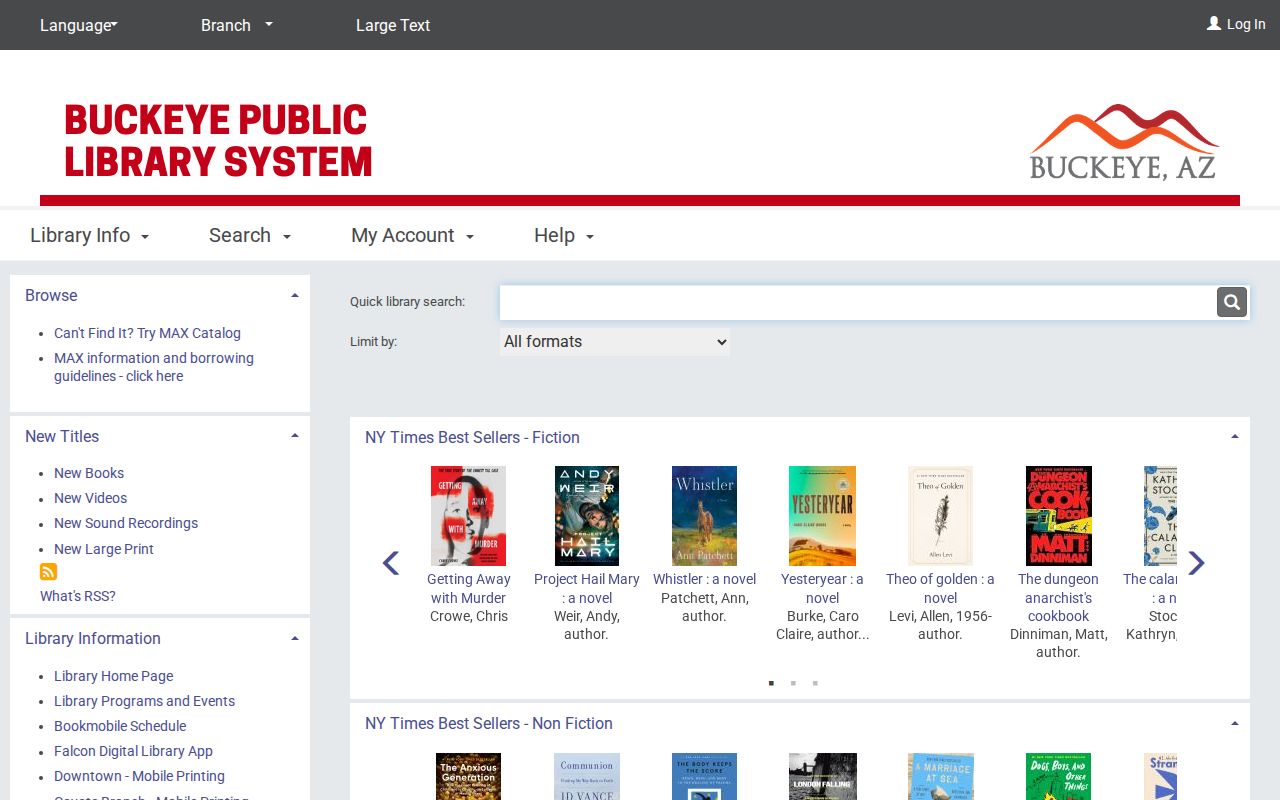
The screen confirms the local access point, but a catalog result is only a finding aid. Record the exact title and holding details, then inspect the volume or database entry itself.
When the local catalog has no match, the State Research Library Arizona Collection is the systematic fallback. Its Phoenix reading room includes city and telephone directories, yearbooks, reports, and genealogy tools. Appointment hours published in the research are weekdays, 8:30 a.m. to noon and 1 to 4:30 p.m. Reference staff can help identify a regional title whose cover never says Buckeye.
Buckeye Inside Regional Directories
A Buckeye city directory search cannot rely on title words alone. The 1916 Phoenix and Salt River Valley catalog record explicitly includes Buckeye. The 1936 Mountain States Phoenix telephone directory also includes Buckeye. In 1949–50, Salisbury Publishing devoted both an alphabetical Buckeye section and a reverse street section to the community. “Phoenix and vicinity” can therefore be useful even when Buckeye is absent from a main cover title.
Place names also changed. Before 1910, newspaper, postal, census, and directory searches should test Sidney as well as Buckeye. The settlement was platted as Sidney in 1888 and standardized as Buckeye in 1910. It did not incorporate until 1929. Earlier names may sit in county, territorial, land, irrigation, or postal records because no city custodian existed yet.
Note: Search the catalog by title, publisher, place, and year because any one field may omit Buckeye.
Decode a Buckeye Directory Entry
The 1949–50 Salisbury entry is rich but compact. A typical line gives surname and given name, a spouse in parentheses, a child or household code, an occupation or employer, an ownership mark, and a home address. Some listings use a post office box or rural route instead of a city street. One documented pattern reads like a compressed biography, but every symbol must be checked against that volume's key.
| Name and spouse | The listed adult appears first; a spouse may follow in parentheses. |
|---|---|
| Household code | A number can reflect the publisher's household or child notation, as defined in its key. |
| Occupation | An abbreviated role and employer can separate two people with the same name. |
| Home field | The h marker and numbered street, box, or rural route locate the listed entry. |
| Tenure mark | ownr is publisher-reported owner context, best checked against a deed. |
The reverse section arranges streets by name and buildings by number. It then places an occupant, owner, or occupancy-status notation beside each address. The same edition says ownership details belong in the alphabetical list. That distinction prevents a reverse listing from being mistaken for a certified title record.
- Criss-cross directory
- A directory arranged by street and house number rather than only by a person's surname.
- Householder index
- An address-order list used to identify the listed person or business at a place.
- Abbreviation key
- The publisher's own guide to marks, shortened occupations, spouse notes, and address codes.
Buckeye City Directory Milestones
The directory shelf reflects Buckeye's growth from a county settlement into an incorporated city. County recording began first, so directory finds often need to be paired with a Maricopa deed or census entry. These verified dates form a useful timeline without filling the gaps with guessed editions.
- 1871: Maricopa County recording responsibility begins, decades before Buckeye becomes a municipality.
- 1916: A Phoenix and Salt River Valley directory explicitly includes Buckeye.
- 1936: A Mountain States Phoenix telephone volume carries Buckeye listings.
- 1949–1950: Salisbury publishes named Buckeye and reverse street sections.
- 1950: The newest public federal population census available in 2026 supplies a household cross-check.
The 1949–50 volume also captured its own period view of Buckeye. It described a farming and rail-linked community west of Phoenix, with rural routes and ties to nearby resort areas. That context explains route addresses and farm or railroad abbreviations. It must not be read as a description of present-day Buckeye.
Trace Buckeye Families by Directory
Family history works best when each Buckeye city directory entry is treated as one dated observation. Start from a known name, address, or year. Keep the title page, publication year, and abbreviation key with the entry. Then move to the nearest earlier and later sources, even if they are a census or newspaper rather than another directory.
- Record a known person, spelling, place, and date from a family paper, deed, census, or obituary.
- Open the closest directory and copy the complete line, including spouse, work, route, and symbol marks.
- Search one edition earlier and later. Test initials, compound surnames, and alternate spellings.
- When an address changes, check the alphabetical and reverse sections in that same edition.
- Pair the 1949–50 entry with the public 1950 census, then verify ownership through the deed record.
- If a person vanishes, search newspapers, cemetery evidence, probate, and the next regional directory.
A missing entry has several possible causes. The person may have moved, died, used an unlisted number, lived outside the canvassed area, or appeared under another name. Publication also lags the date on which information was gathered. Absence is not proof of absence from Buckeye.
Buckeye Records Between Editions
The Buckeye Valley News title history offers an unusually strong bridge between directory dates. Digitized issues begin in February 1912 and continue under related titles through September 1950. The main title alone has 657 digitized issues through May 1935; later continuation titles add 13 and 788 issues. Community notices, marriages, deaths, visitors, church events, school news, and advertisements can connect a name to a place between the verified volumes.
Search OCR, the machine-read text, with several forms of a surname. Then inspect the page image. Small type and old print often cause names and street text to be read poorly. The paper also covered Liberty, Palo Verde, and Arlington, so a Buckeye newspaper mention does not always place the person inside the incorporated city.
Yearbooks and obituaries add different clues. A yearbook can connect classmates to a school year. An obituary may name relatives or a former home. Both are published accounts rather than government findings, and each should be checked against census, probate, cemetery, or directory evidence.
Buckeye Directory Reading Rooms
The Arizona Memory Project city and business directory collection supplies the main digital shelf. Its volumes can be browsed by page, image, OCR, or downloadable format when an item supports those options. The collection description notes that directories can show occupation, widow or household status, and an ownership-status mark.
The Arizona Historical Society library and archives adds catalogs, finding aids, manuscripts, and photographs. Most of its holdings are offline. Appointment and staff help are normal access channels. Its Arizona Heritage Center library closed for renovation beginning May 17, 2026; staff still handles email and telephone inquiries, but some requests may take weeks or cannot be filled during the closure.
The Arizona State Archives and State Research Library remain the practical alternate route. A local option is Buckeye Valley Museum, which offers local-history exhibits, about 15 named oral histories with audio or transcripts, and staff contact. Oral history can supply context, but names and dates still need a documentary check.
Preserve Buckeye Directory Gaps
A sound Buckeye city directory search states what is not known. No verified source found a continuous Buckeye-only annual series. No last printed year was established. Buckeye coverage in later Greater Phoenix criss-cross volumes was not confirmed. A Sanborn fire-insurance sheet for a particular Buckeye block also must be located by place and date before it can be used.
Modern parcel data should not be read backward as if today's street and city limits always existed. Buckeye's annexation map spans 1929 through 2022, while early evidence can use Sidney, rural routes, subdivision names, or county land descriptions. The full modern address chain belongs in the Buckeye street directory; a historical citation should keep the words and route exactly as the old source printed them.
Note: Report an unverified year as a gap, not as proof that no Buckeye directory was published.