
Buckeye Resident Lookup Sources
No single roll is a complete Buckeye residents directory. The best source depends on the fact being tested. The Maricopa County Assessor ties a named owner to a parcel, while the Recorder shows parties to a recorded instrument. Arizona court indexes show public case roles and events. Current birth and death certificates use an eligibility process rather than an open name search. Business and professional databases show public affiliations, not a private home. A sound Buckeye resident lookup treats each result as one piece of evidence.
| Record | What It Confirms | Where to Search | Access |
|---|---|---|---|
| Assessor parcel | Owner, APN, mailing and situs addresses | Maricopa County Assessor | Free search; ownership is not occupancy |
| Recorded document | Named parties, transfer, legal description | Maricopa County Recorder | Free index and unofficial image; official copies cost |
| Court case | Name, role, court, events and disposition | Arizona Public Access or court clerk | Discovery is free; exclusions apply |
| Vital record | Birth, death, marriage, or divorce evidence | County, ADHS, or Superior Court Clerk | Current certificates require eligibility |
| Business or license | Entity or credential affiliation | ACC eCorp or Arizona eLicense | Public role data; not proof of residence |
Start with the most stable fact. An address can yield an assessor parcel number, or APN, and a present owner. A court case number identifies one matter without relying on a common name. An entity ID or license number does the same for a public affiliation. When only a name is known, add a middle name, date, spouse, former city, or co-party before drawing a conclusion. This two-fact rule keeps a resident lookup from turning a plausible match into a false claim.
Note: A public role, mailing address, or property interest supports only the fact stated in that record, not present Buckeye occupancy.
Confirm Buckeye Court Matches
Arizona Public Access Case Lookup is a discovery tool covering most, but not all, Arizona courts. It requires verification characters before a party or case-number search. Party mode accepts first, middle, and last names, then allows court, county, and case-type narrowing. For a Buckeye resident lookup, select Maricopa County or the relevant Buckeye court when possible and run spelling variants separately.
A result may show the court and county, case number, case type, status, filing dates, party names and roles, charges, dispositions, or docket events. It may still be incomplete. Sealed matters, protection orders, juvenile cases, mental-health records, and protected victim or witness data are excluded. Maricopa Superior Court coverage is partial in the statewide system. The court of record remains the authority.
The Arizona eAccess service offers eligible Superior Court civil and criminal documents filed from July 1, 2010, after registration and payment. Older records and files not offered online go through the Clerk or courthouse. The source screen below shows why the case index is a starting point, not the final record.
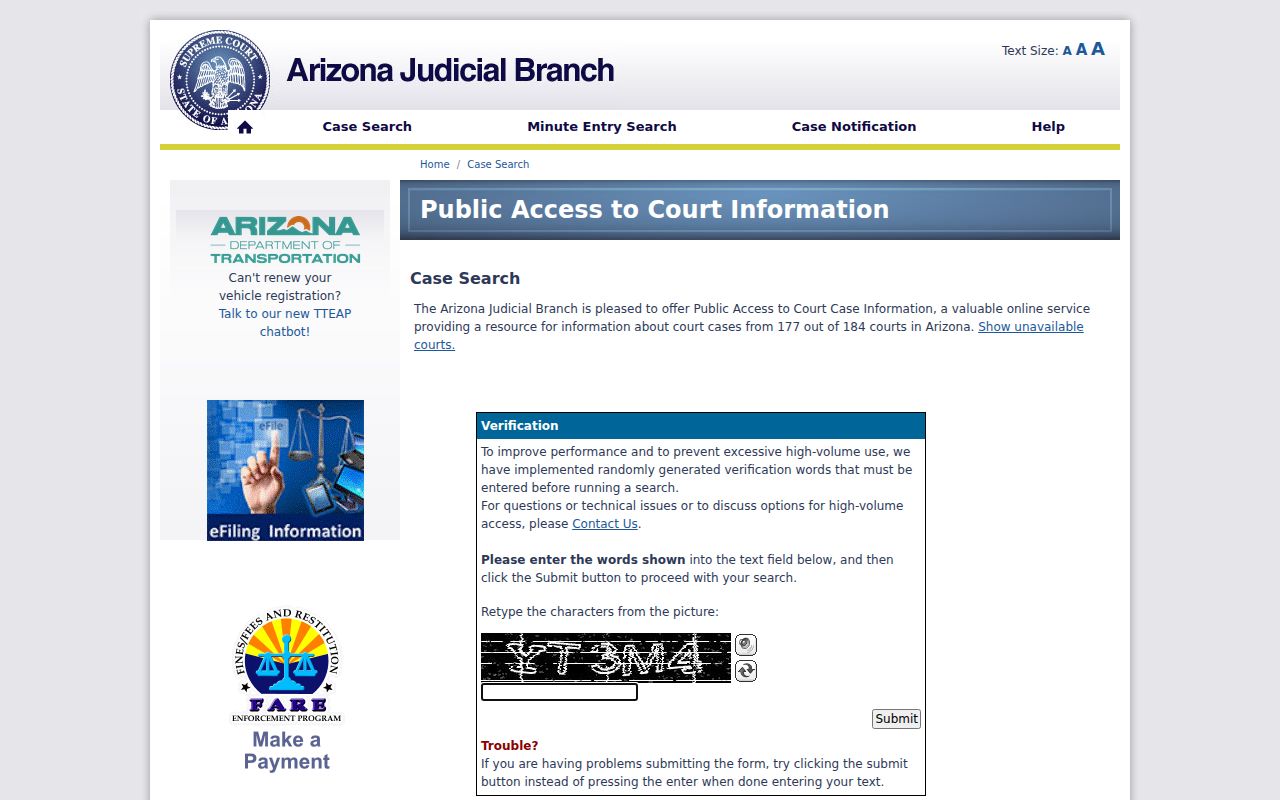
The verification gate and search controls help narrow a name, while the clerk supplies the official file or copy.
Buckeye Resident Court Record Fields
Read the result as an inventory, not a biography. A same-name person in another court may have no link to Buckeye. Compare the listed court, filing date, co-parties, charge or claim type, and exact case number against the facts already known. A disposition is the outcome recorded for a charge or claim. A docket is the dated list of events and filings in one case.
- Court, county, case number, title, and case type
- Filing date, status date, and current status
- Party names, roles, and public co-party names
- Public charges, counts, statutes, and disposition fields
- Event or docket descriptions with their dates
Federal matters use PACER, which supports party and case searches for the District of Arizona and nationwide discovery through its Case Locator. PACER generally bills by page, applies a document cap, and waives small quarterly totals under its stated policy. The federal search interface pictured below is separate from Arizona state and Buckeye municipal systems.
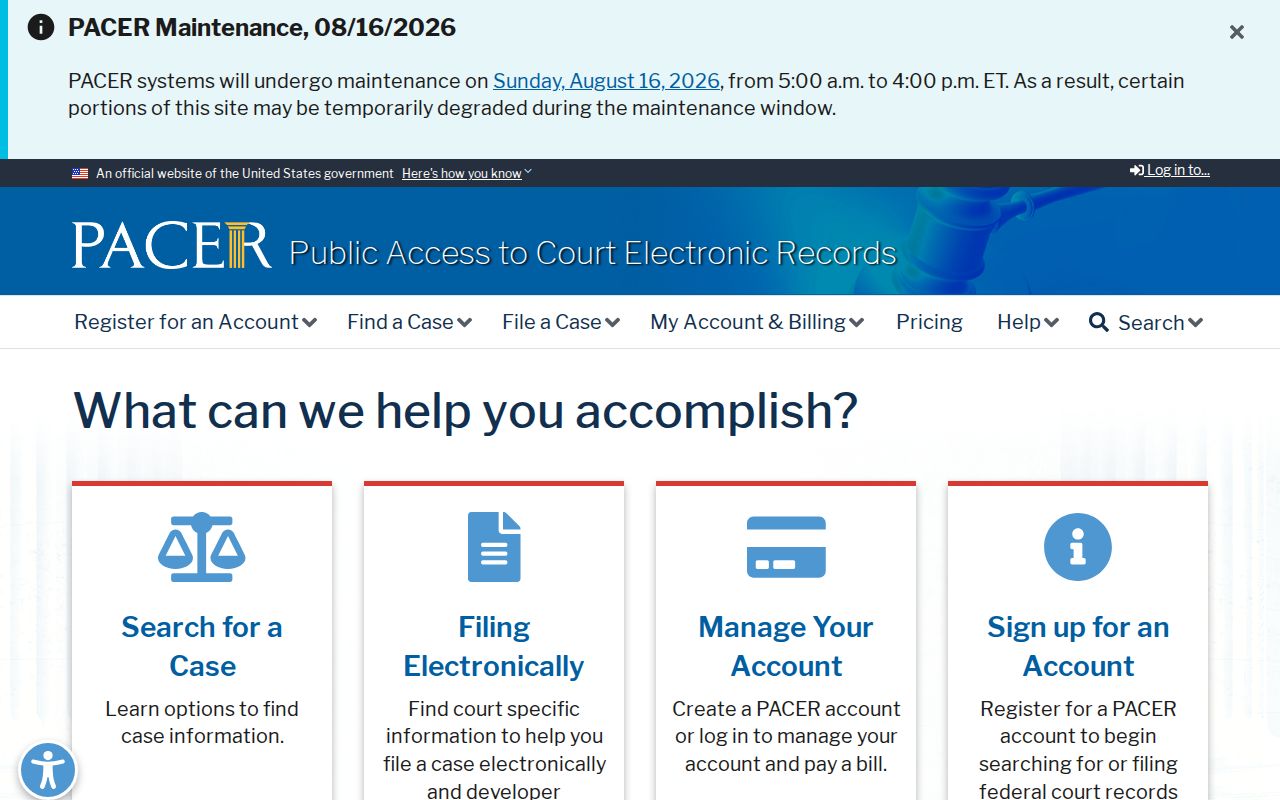
A federal result should be matched by case number and court, then checked against the official docket rather than blended with a state-court name hit.
Verify Buckeye Resident Records
A reliable resident lookup anchors a name to a stable identifier, then asks a second source to confirm the connection. The following sequence works when a present or former Buckeye address is known. It proves only what each official record says. It does not turn an owner, party, agent, or license holder into a confirmed occupant.
- Search the Maricopa Assessor by address. Save the owner name, APN, situs address, mailing address, and deed number without treating the owner as every person at the property.
- Search the Recorder under the exact owner name and reasonable variants. Match the document number, date, and legal description to the parcel.
- Run the court party search with first, middle, and last names. Narrow to the right court, then compare case number, date, and co-parties.
- Use a public historical vital image, probate file, marriage record, entity ID, or license ID only when that source answers the open question.
- Request an official or certified copy from the custodian when the record must carry formal proof.
- Docket
- The dated list of filings, hearings, and actions in one court case.
- Index versus image
- An index summarizes searchable fields. An image displays the filed or recorded document, if public and available.
- Certified copy
- A copy authenticated by the custodian as a true copy of its official record.
Note: A document number, APN, case number, entity ID, or license number is safer than a name alone.
Buckeye Vital Record Boundaries
Current Arizona birth and death certificates are not open people indexes. Maricopa County Vital Registration and the Arizona Department of Health Services issue copies to eligible applicants who supply identification and proof of relationship or legal authority. Applications ask for the subject's legal name, event date and place, related family facts, the requester's contact details and eligibility basis, copy choice, signature, payment, and supporting proof.
Arizona vital-record services distinguish modern certified copies from genealogy access. The current certified-copy fee in the research is $20. Mail requests require the specified identification or notarization, an original signature, payment, and a return envelope. Marriage licenses come from the Maricopa Clerk. Divorce decrees remain court files.
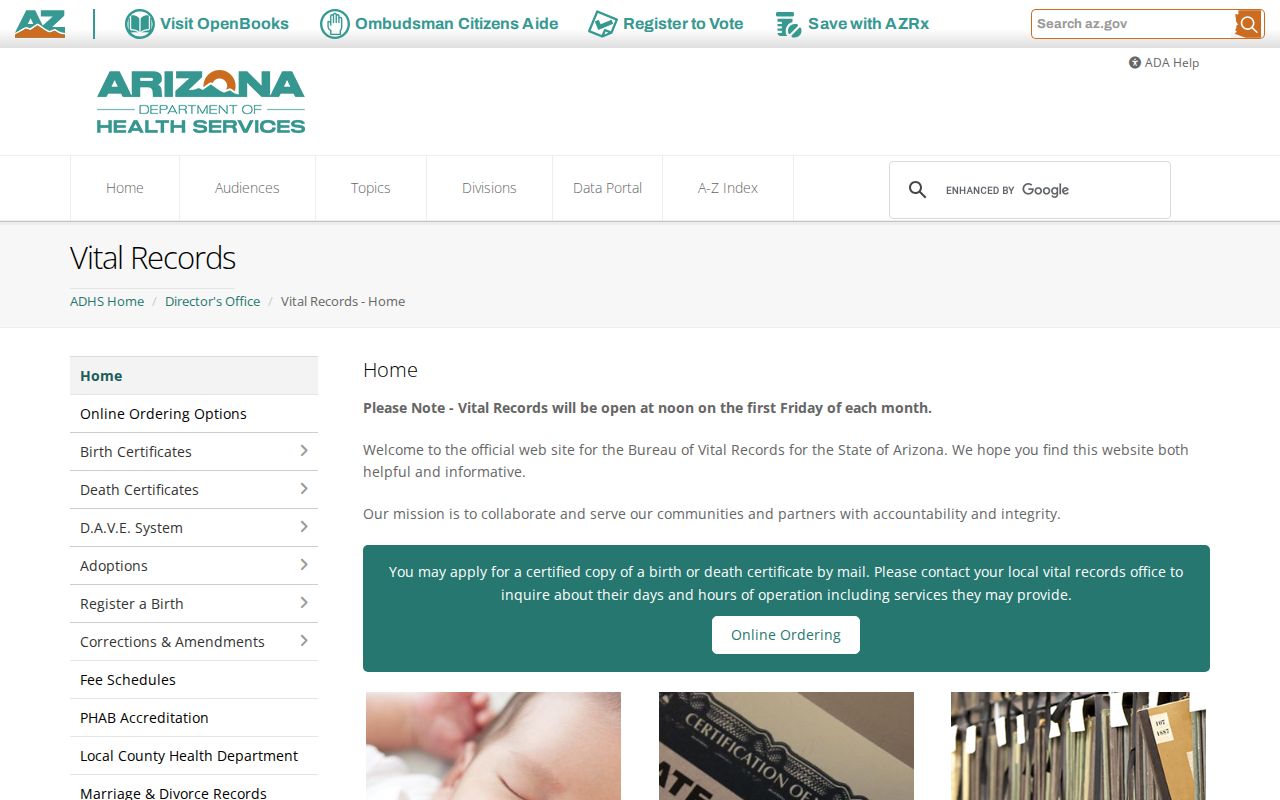
The application paths shown here reinforce the key limit: personal curiosity alone does not create eligibility for a current certificate.
Historical access is different. Arizona opens genealogy images 75 years after birth and 50 years after death under A.R.S. §36-351(B). The free ADHS genealogy portal labels births from 1855 through 1945 and deaths from 1870 through 1970, though displayed ranges can lag the rolling rule. Historical images are noncertified evidence. They should be paired with archives, cemetery, newspaper, probate, or census sources.
Buckeye Resident Voter Limits
The Arizona Voter Information Portal is an individual's status, polling, and ballot tool. It is not a public name directory. Its lookup requires identifying facts, including county, last name, date of birth, and an identification method and number. The screen below illustrates why it cannot be used to browse Buckeye residents by name or block.
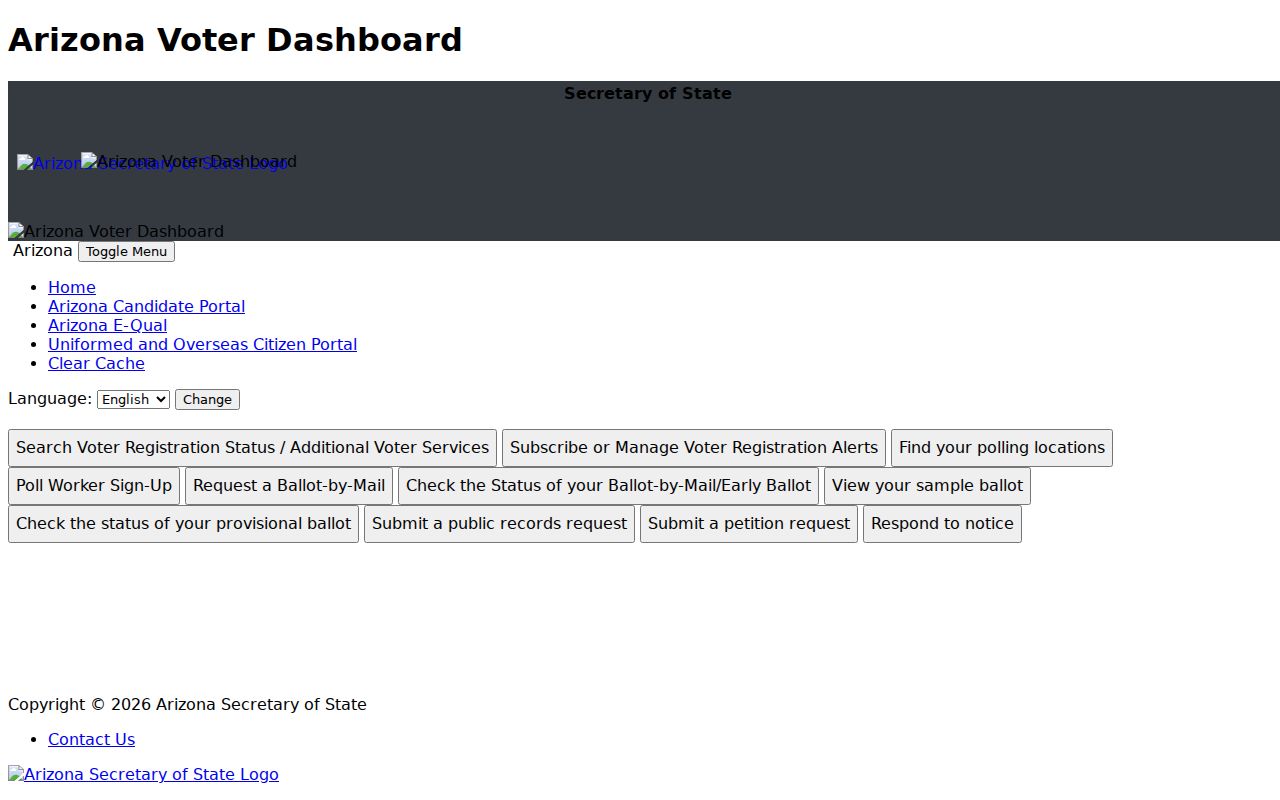
The form serves a voter checking their own record; it does not offer a general resident lookup.
A.R.S. §16-168 controls separate voter-list requests. It limits permitted uses, bars Internet redistribution, and shields sensitive fields such as signatures, email addresses, full birth details, and government identifiers. Misuse can be a class 6 felony. An authorized list can confirm electoral registration within its legal purpose, but it cannot establish every person who lives at an address.
Myth check. Arizona voter data cannot be turned into a public Buckeye block directory, even when property records for the same area are open.
Confirm Buckeye Heirs and Affiliations
An heir search can move from a known deed to the current parcel, then backward through the seller's earlier purchase. When a named owner has died, a public probate file, obituary, cemetery record, or death genealogy image may connect relatives. Match legal descriptions, APNs, document numbers, dates, and co-parties. Probate evidence can identify an estate or heir when public, but sealed or redacted material ends that trail.
Public affiliation tools answer different questions. Arizona Corporation Commission eCorp can show entity name, ID, type, status, formation date, jurisdiction, known place of business, statutory agent, and filing history. Arizona eLicense checks participating professional boards. A statutory agent can be a service company, and a business address may serve a public role. Neither proves that a named person resides there.
For a former classmate, Buckeye Public Library databases, State Research Library yearbooks, newspapers, and obituaries are better aligned with the goal. A birth-parent inquiry must follow Arizona's official adoption, confidential-intermediary, and court process. Sealed adoption records and protected addresses must never be reconstructed from adjacent sources.
Note: Probate and obituary clues may identify family links, but the original deed or court file remains the record to cite.
Buckeye Lookup Request Channels
When an online search stops, use the office that holds the record. Buckeye Municipal Court publishes a written request form for complaint or citation records, warrants, disposition information, plea material, motor-vehicle abstracts, certifications, or audio. Requests may be delivered by pickup, fax, or mail. Its stated charges include a $17 name search covering up to three cases for one name, $0.50 per page, $17 certification per case, and $17 for an audio CD.
Superior Court files use the Clerk's online ordering channel, eAccess where eligible, or a courthouse counter. City-held records go through the Buckeye public-records process. Arizona Public Records Law opens records in a custodian's care during office hours, subject to privacy, confidentiality, court rules, and redaction. A request should identify an existing record, a likely office, a name or case number, and an approximate date range. The law's prompt standard is not a fixed production deadline.
Correct an error at its source. A private suppression request does not revise an assessor, court, deed, or license record. Save the exact record identifier, contact the custodian, and ask for its correction or annotation process. That protects the next Buckeye resident lookup from repeating the same mismatch.
Lawful Buckeye Resident Lookup
Arizona's Address Confidentiality Program provides a substitute address and mail forwarding for eligible protected participants. Protected voter addresses and similar confidential fields are not gaps to work around. Stop the search when a lawful program hides the location. Motor-vehicle personal information is also restricted, and modern vital certificates remain subject to eligibility rules.
Commercial people-finder data can be stale, merge names, or attach relatives and addresses to the wrong person. Treat that category only as an unverified lead. Corrections belong with the government custodian, while a commercial privacy concern belongs in that service's suppression channel. Public records can be used for family history, heir research, reconnection, consumer safety, and civic understanding, but access never grants permission to pressure a person.
Lawful use. A Buckeye resident lookup is for lawful personal research. Arizona law prohibits using records to stalk, harass, threaten, or intimidate anyone.