
Find Buckeye Residents
A useful Buckeye residents directory search starts with the kind of clue already in hand. An address belongs first in the Maricopa County Assessor search because it turns a street label into an owner, mailing address, parcel number, subdivision, and deed reference. A name can move through the assessor, Recorder, court party index, corporation records, professional licenses, unclaimed property, and historical sources. An old year belongs in directories, newspapers, census schedules, and archives. No single result proves present residence. A parcel record proves titled ownership, while a directory entry is stronger evidence that someone was listed at an address in its publication year.
Start with two known facts whenever possible. A middle name, former address, spouse, approximate age, parcel number, case number, or entity ID can keep two people with the same name from being merged. Buckeye records also split by government level. City files cover municipal operations. Maricopa County holds deeds, property, probate, marriage, and Superior Court material. Arizona supplies statewide discovery and restricted vital services.
- Search the county property roll by exact address or owner name and save the APN.
- Use the owner or business name in the Recorder index, then match the legal description.
- Check court, entity, license, or unclaimed-property indexes only when they fit the question.
- For an earlier household, move to dated directories, newspapers, census records, and probate.
- Ask the actual custodian for a copy when the online index stops or omits the document.
Buckeye Records Office Map
Office choice controls both speed and accuracy. Buckeye City Hall is the local fallback for council, planning, permit, code, and administrative files. The city court keeps its own filed municipal cases. County offices in Phoenix control the high-value resident trails: the Assessor identifies a parcel, the Recorder indexes recorded instruments, and the Clerk of Superior Court supplies court, probate, and marriage records. Arizona Public Records Law opens existing government records for inspection during office hours, but confidentiality laws and court rules still permit withholding or redaction.
Maricopa County Recorder
301 W. Jefferson St., Suite 200
Phoenix, AZ
602-506-3535
The full address workflow belongs in the Buckeye street directory. At the office level, the key is simple: start where the record was created, not where a convenient search result happens to appear.
Search Buckeye Property Rolls
The Maricopa County Assessor is the best first roll for an address. Its search accepts a parcel number, full owner name, standardized street address, subdivision, or registered-property clue. A failed address may work after the street type is omitted. The parcel card separates the physical, or situs, address from the owner's mailing address. It can also show subdivision and MCR references, lot and block, deed number and date, sale details, construction year, jurisdiction, and value fields. Mailing and situs matching can support an owner-occupancy theory, but it does not identify every person in the household.
| Search key | Best format | What to save |
|---|---|---|
| APN | With or without punctuation | Stable parcel identity |
| Owner | Full unabbreviated name | Mailing and situs distinction |
| Address | Number, direction, street, short type | Physical ZIP and jurisdiction |
| Subdivision | Recorded or MCR name | Lot, block, tract, and map reference |
- Parcel
- A mapped unit of land identified by an assessor parcel number.
- Situs address
- The physical property address, which can differ from the tax-mail address.
- Index
- A finding aid that points to a record; it is not always the complete document.
- Criss-cross directory
- A printed directory arranged by street and house number instead of only by surname.
The Assessor maintains more than 1.8 million property accounts across Maricopa County, so tight inputs matter. Save the APN before leaving the result. It is the cleanest bridge from a Buckeye address to Parcel Viewer, the Treasurer tax account, a recorded plat, and the deed reference shown on the parcel card.
Buckeye Resident Deed Index
An address does not go straight into the older Recorder name index. First translate it through the Assessor into the current owner, APN, legal description, and deed number. Search a natural person under last and first name. Trusts, companies, subdivisions, and homeowners associations belong in Business Name. Recorder results identify indexed parties and roles, document type, recording date, document number, page count, and an image link when one is available. The instrument may add the grantor, grantee, legal description, return address, and recording stamp.
Maricopa County has recorded documents since 1871, before Buckeye became a city. That institutional date does not mean every old image or field is online. Free unofficial images are useful for research. Official copies cost $1 per page, with $3 added for certification of a document. Older or incomplete trails can continue at the Recorder counter, through mail and public-data request forms, or in deed books. Match property facts, not a name alone.
Note: Recorder full-text searching covers only the latest two years, while older deeds remain discoverable through names, dates, codes, and document references.
Buckeye Resident Sources Now
Current public sources act like partial directories. They cover distinct groups and cannot be added together as if they were a census of Buckeye. The property roll lists owners, not all occupants. A deed identifies parties to a transfer. Court and business systems show a public legal role. The voter portal serves an individual's own registration lookup, while broader voter files are purpose-limited by Arizona law. Public association pages normally name officers and contacts, not private members.
| Public source | Evidence shown | Record keeper | Access path |
|---|---|---|---|
| Property roll | Owner, parcel, mailing and situs | Maricopa Assessor | Free web search and office help |
| Recorded documents | Parties, deeds, liens, plats | Maricopa Recorder | Free index, copies by web or mail |
| Court cases | Party role, case, public docket | Local or Superior Court clerk | Discovery portal, clerk, or eAccess |
| Entity and license files | Public role, status, business contact | Arizona agencies and boards | Official verification portals |
| Library and archives | Dated occupant and family clues | Libraries, archives, historical groups | Digital browse, card access, or appointment |
A one-name search needs careful comparison across sources. The dedicated Buckeye resident lookup explains how to verify a match without treating a weak clue as proof.
Buckeye Resident Court Matches
Arizona Public Access can discover cases from participating courts by party name or case number, with county, court, and case-type filters. It covers most, but not all, Arizona courts and warns that the display is not the official record. Sealed matters and several sensitive case classes are excluded. Maricopa Superior Court is only partly represented. Confirm a useful case number with Buckeye Municipal Court, the Maricopa Clerk of Superior Court, or the court named on the result.
The Arizona eAccess service supplies eligible Superior Court civil and criminal documents filed from July 1, 2010, subject to exclusions, account rules, and fees. Its current access screen illustrates why discovery and document delivery are separate steps.
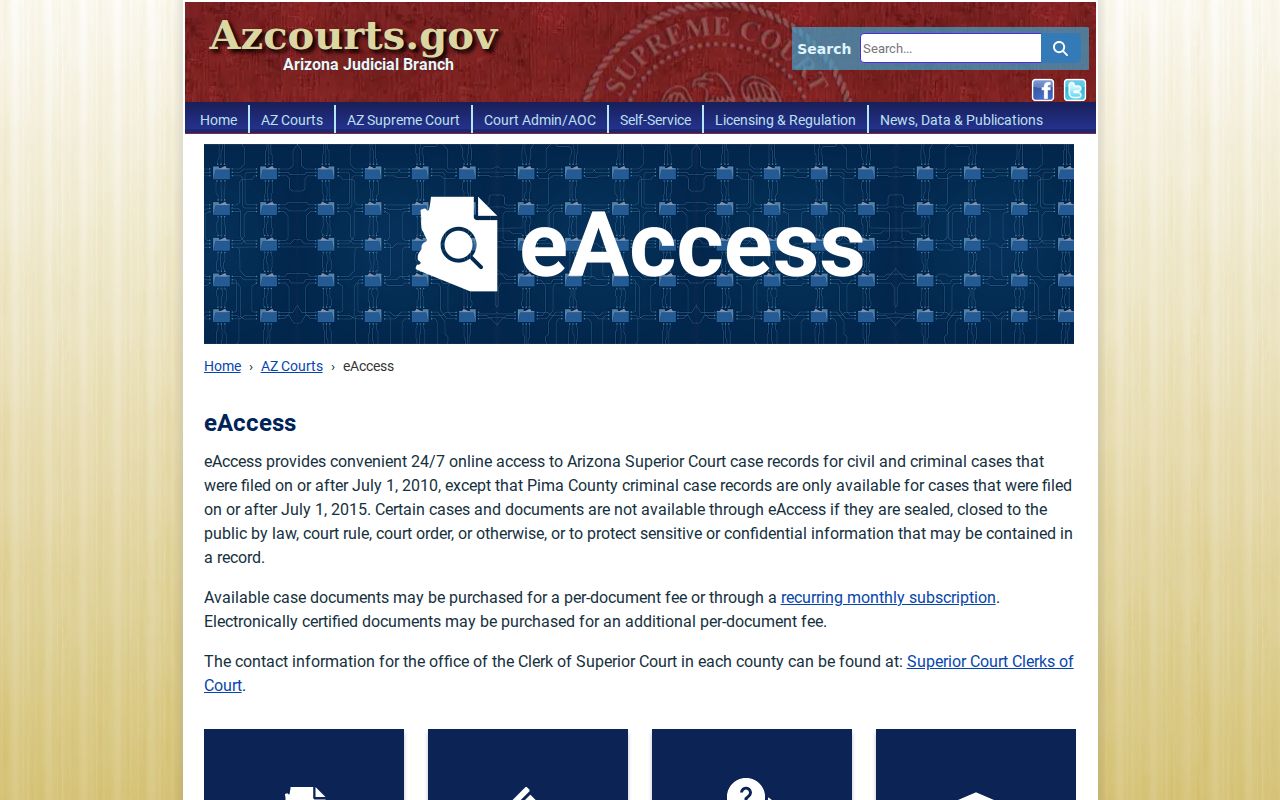
The eAccess notice should be read before assuming an older, family, probate, sealed, or otherwise excluded file will appear. Clerk order channels and courthouse terminals remain the fallback.
Buckeye Resident Vital Limits
Birth and death certificates are not open current-name indexes. Maricopa County Vital Registration and the Arizona Department of Health Services issue certified copies only to eligible requesters who supply identification, proof of relationship or authority, and payment. Marriage licenses come from the Maricopa Clerk. Divorce files remain court records. For older family research, the free ADHS Genealogy Search offers noncertified images after the statutory interval, and its displayed ranges currently cover births from 1855 through 1945 and deaths from 1870 through 1970.
The Maricopa County vital-records channel separates applications and eligibility from a casual residents directory query.
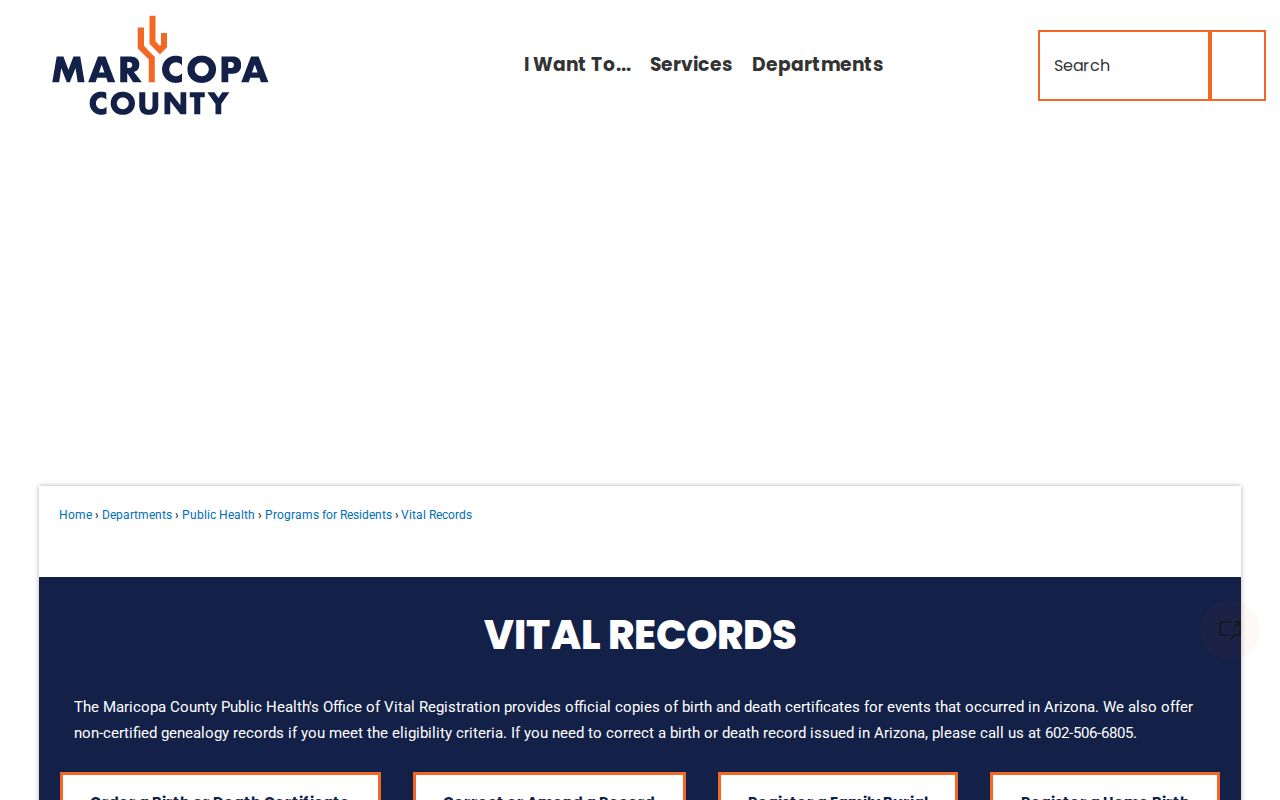
That split protects current records while leaving a lawful route for eligible copies and much older genealogy work. A public historical image still is not a certified modern certificate.
Buckeye Resident Voter Limits
The Arizona Voter Information Portal is a self-service status and polling tool, not an open Buckeye residents directory. Broader precinct and electronic list data is governed by A.R.S. §16-168. The statute limits authorized uses, prohibits Internet redistribution, withholds sensitive fields, and makes misuse a felony. Protected records cannot be recovered by filing a generic request. A registration also confirms an electoral record, not every resident at the address.
Lawful use. Public records may support family history, civic research, property questions, and personal safety, but never stalking, threats, harassment, or attempts to defeat a protected address.
The safe rule is narrow. Use the portal for the individual lookup it was built to provide. Property and voluntary community sources are better tools for geographic questions, and even those sources must not be used to pressure or track a person.
Buckeye Resident Request Fallback
When an index ends, ask the office that created the record. A good request names the record type, department, date range, address, APN, permit or case number, and desired format. Arizona Public Records Law requires access to existing records, but it does not force an agency to answer research questions or create a new report. A.R.S. §39-171 requires acknowledgment within five business days in covered situations. That is not a five-day production promise.
Buckeye municipal files go through the city clerk or the department named in the request. City Hall is open Monday through Friday from 8 a.m. to 5 p.m. Municipal court records use a separate written form and may be picked up, mailed, or faxed. County deeds and elections data use Recorder channels. Older court, probate, and marriage material may require the Maricopa Clerk's order process or a courthouse visit.
Buckeye Residents Beyond Portals
Some useful resident leads sit outside the familiar parcel and court systems. Arizona Corporation Commission eCorp identifies public entity roles and filing history. Professional boards verify credentials. Arizona Department of Revenue Unclaimed Property can provide a name and reporting-owner clue, though a claim requires proof. These sources show affiliations or claim paths, not residence by themselves. Jail, prison, and offender tools cover different legal populations and must be verified against the relevant agency and court.
The official Arizona unclaimed-property search is free and avoids firms that charge for the same starting point.
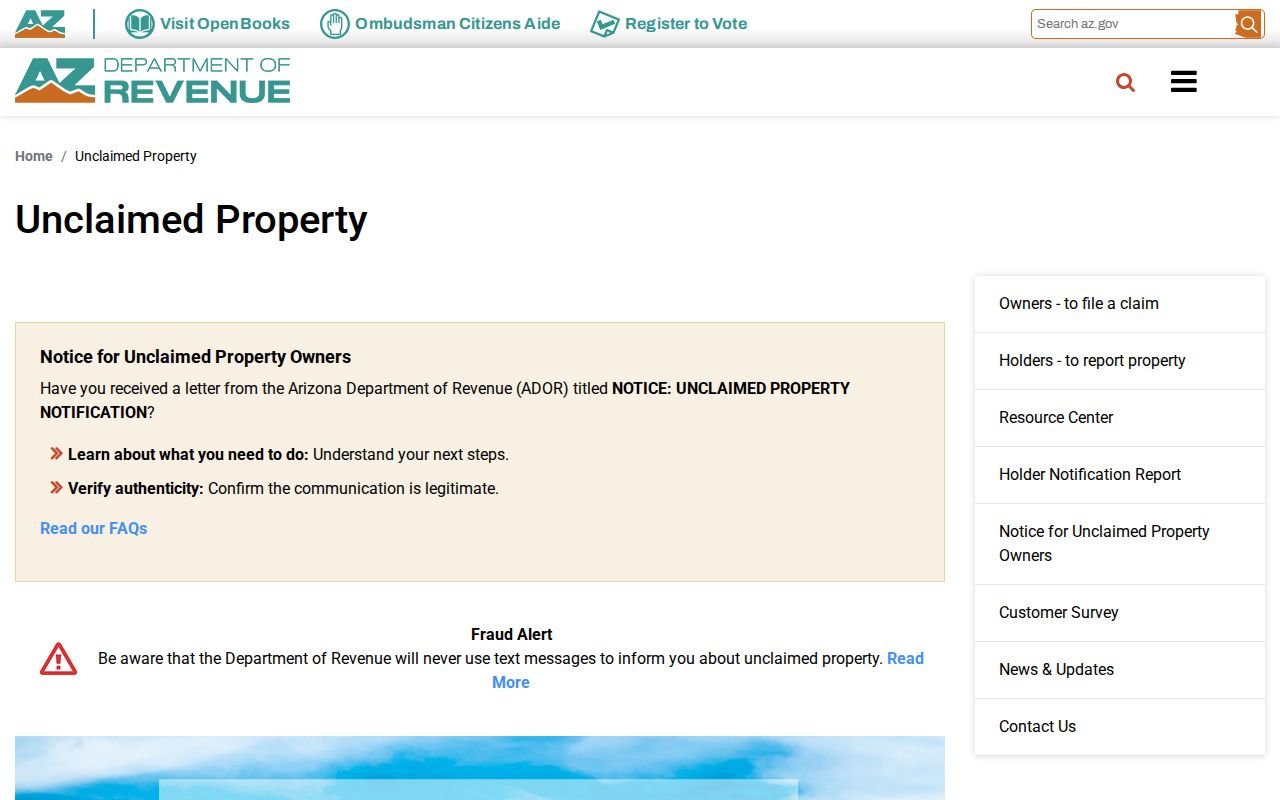
A matching name is only a lead. Compare the listed location clue and follow the state's proof process before treating it as the right Buckeye resident.
Historic Buckeye Directory Trail
Buckeye's printed record trail is regional and uneven. Verified milestones include the 1916 Phoenix and Salt River Valley directory, a 1936 Mountain States Phoenix telephone directory, and Salisbury's 1949-1950 North and West Maricopa County volume. The last has both a Buckeye name section and a reverse street section. Entries may show a spouse, household code, occupation, owner mark, home address, rural route, or telephone. The Arizona Memory Project provides digitized browsing, while the State Research Library keeps city and telephone directories and yearbooks in Phoenix.
The latest public federal census is 1950 under the 72-year release rule. Pair a dated city directory with census, newspaper, obituary, deed, and probate evidence. Buckeye Public Library offers in-library Ancestry access and a local catalog, but no verified source establishes a continuous Buckeye-only annual run. The complete shelf and reading method belong to the historical city directory section of the site.
Buckeye Directory Growth Shifts
Record geography changes with the city's growth. Historic downtown and the 85326 area are more likely to yield older telephone, school, farming, and newspaper clues. Verrado and the 85396 growth area are better represented by recent assessor records, subdivision plats, permits, association contacts, and digital deeds. USPS created 85396 from part of 85326 in 2005, but neither postal area equals the incorporated city line. City annexation maps, assessor jurisdiction, and USPS delivery checks answer different questions.
Older name searches need their own place logic. The settlement was platted as Sidney in 1888 and standardized as Buckeye in 1910. It incorporated in 1929. Pre-1910 newspaper, land, postal, and census searches should test both place names, while pre-incorporation civic evidence often lives at county or state level. County recording starts in 1871, long before a Buckeye city office existed.
Protect Buckeye Resident Searches
Official records can also expose a scam. The Maricopa Recorder sells ordinary copies at a modest per-page charge and offers free Title Alert monitoring for newly recorded documents after enrollment. Arizona unclaimed-property claims start free. Court or jury callers who demand gift cards or cryptocurrency should be checked through an independently found court number. A records result is safer when it includes a stable APN, document number, case number, or entity ID and is confirmed at the source.
Maricopa Title Alert began in 2023 and watches an unlimited set of enrolled personal or business names for later recordings. It is prospective. It cannot reconstruct an old deed chain, replace title insurance, or decide whether a filed instrument is valid. The Recorder reported that more than 90 percent of its documents in the first quarter of 2024 were recorded digitally, which helps explain why a new item may surface quickly while much older Buckeye research still depends on structured name searches, document references, counter help, and deed books.
An official Buckeye residents directory trail and a commercial compilation serve different roles. The first exposes the custodian, record number, access rule, and correction route. The second may merge names, preserve old addresses, or misstate family links. A commercial result can be a clue, but it should not replace the underlying Buckeye record.
| Search path | Strong point | Needed check |
|---|---|---|
| Official index | Named custodian and stable identifier | Open the record or order the file |
| Historical collection | Dated Buckeye household context | Confirm the edition and source page |
| Commercial compilation | Broad lead gathering | Verify each claim in an official or archival source |
Corrections belong at the source. An Assessor ownership error goes to the Assessor, an index issue to the Recorder, and a court error to the filing court. Private compilation suppression does not erase the government record. The Buckeye residents directory method is therefore to find the responsible office, preserve the identifier, inspect the record, and stop when a legal restriction or protected address ends the search.
The Arizona DPS public-safety resource shows another official source with its own statutory scope.
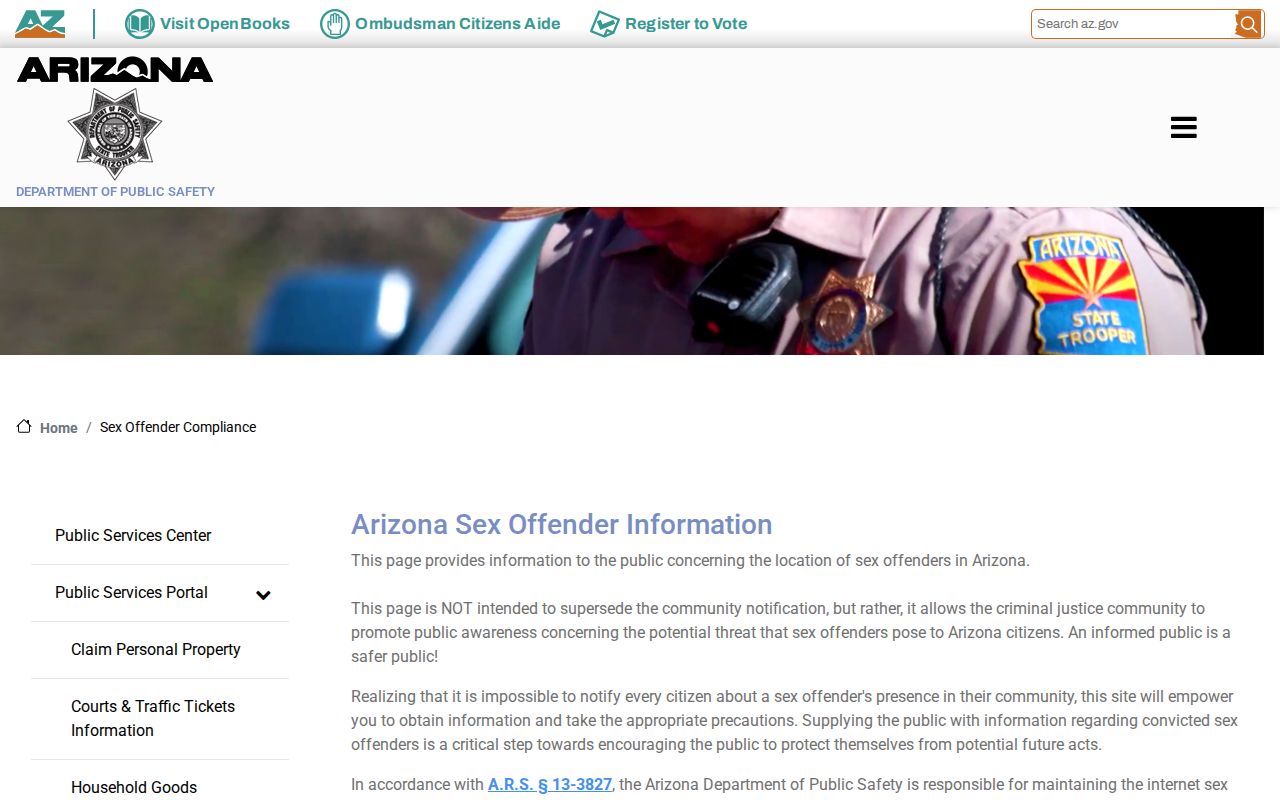
Use only the information the agency lawfully publishes. It is not a complete residents roll, and no result authorizes harassment or harm.